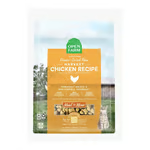
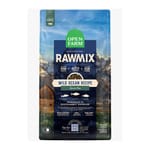
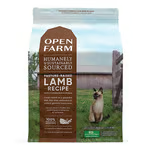
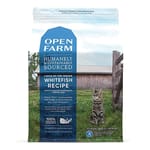
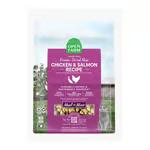
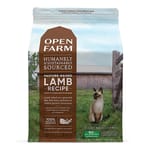
Open Farm cat food is a category of food specifically formulated for felines, encompassing various recipes and forms designed to provide the daily nutrition required by cats. Products within this category typically feature different types of meat, fish, or plant-based proteins, often supplemented with a range of vitamins and minerals. The selection of Open Farm cat food may include dry kibble, wet food, or freeze-dried options, catering to diverse dietary preferences and life stages of cats. When choosing, pet owners can select appropriate formulas based on their cat's age, activity level, and specific health considerations. Additionally, for some products, other pet food options such as Open Farm dog food may be available to meet the needs of different household pets. This product category primarily supports the normal physiological functions and overall well-being of cats, without making any medical claims regarding treatment or health improvement.
Open Farm cat food refers to a category of commercially prepared feline diets formulated by the brand Open Farm, characterized by specific ingredient sourcing and manufacturing philosophies.
This article aims to describe the structural attributes, material composition, and usage contexts within the Open Farm cat food category, focusing solely on verifiable, objective information rather than product recommendations or comparative advantages.
Classifying Open Farm Cat Food: Practical Divisions
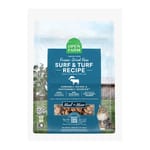
Open Farm cat food products are commonly divided based on their form and the primary life stage they are intended to support. The most prevalent forms include dry kibble and freeze-dried raw formulations. Dry kibble, also known as extruded pet food, is produced by grinding ingredients, mixing them with water, and then cooking them under high pressure and temperature before shaping and drying. Freeze-dried raw cat food, conversely, involves a process where raw ingredients are frozen and then placed in a vacuum chamber, causing the ice to sublimate directly into vapor, preserving the nutritional integrity without high heat. Life stage divisions typically include formulations for kittens, adult cats, and sometimes specific formulations targeting senior cats, though the latter is more frequently observed in Open Farm dog food lines. These distinctions in form and life stage are fundamental to understanding the product range within Open Farm cat food offerings.
Open Farm Cat Food: Material Composition and Processing Techniques
The material composition of Open Farm cat food is a defining characteristic, emphasizing specific ingredient sourcing. Proteins, often from animal sources such as salmon, turkey, chicken, or lamb, constitute a significant portion of the formulations. These animal proteins are frequently described with attributes like "wild-caught" or "humanely raised," indicating specific sourcing protocols. Carbohydrate sources, when present, typically exclude common grains in many formulations, aligning with a "grain-free" approach. Instead, ingredients such as legumes (e.g., lentils, chickpeas) or certain vegetables (e.g., sweet potatoes) may be utilized. Fats, essential for feline energy and nutrient absorption, are derived from sources like salmon oil or chicken fat. Additionally, a range of vitamins, minerals, and often prebiotics or probiotics are incorporated to complete the nutritional profile. The processing techniques vary significantly between dry kibble and freeze-dried options. Dry kibble production involves extrusion, which utilizes heat and pressure. This process gelatinizes starches and creates a shelf-stable product. Freeze-drying, on the other hand, minimizes heat exposure, aiming to retain the original nutrient profiles of raw ingredients. This method results in a product that can be rehydrated or fed dry, offering a different textural and nutritional experience compared to extruded Open Farm cat food.
Open Farm Cat Food: Properties Across Usage Environments
The properties of Open Farm cat food formulations can exhibit variations depending on the usage environment and storage conditions. Dry kibble, due to its low moisture content and extruded nature, typically offers a longer shelf life and greater stability in ambient temperatures, provided it is stored in a cool, dry place away from direct sunlight and humidity. Its compact form factor makes it suitable for automated feeders or for leaving out for extended periods without significant degradation. Freeze-dried raw Open Farm cat food, while also shelf-stable in its dry form, requires different handling once rehydrated. Rehydrated freeze-dried food, with its increased moisture content, becomes more susceptible to bacterial growth and spoilage, necessitating prompt consumption, typically within a few hours, and refrigeration of any uneaten portions. The physical consistency and palatability can also be influenced by environmental factors; for instance, dry kibble may become less appealing if it absorbs moisture and becomes stale, while freeze-dried products might be less appealing if not properly rehydrated to the desired texture. These factors highlight how the intended usage context dictates the optimal handling and storage protocols for different Open Farm cat food types.
Open Farm Cat Food: Product Characteristics from Sales Ranking
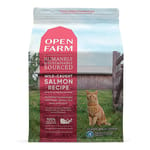
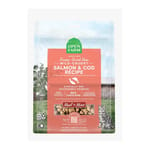
Rank 1: Open Farm Grain-Free Cat Food Wild Salmon 8lb (OFSA-8C) — This product is a dry kibble formulation. Its primary protein source is wild-caught salmon. The formulation is grain-free, indicating the absence of ingredients such as corn, wheat, or soy. It is designed as a complete and balanced diet for adult cats. The 8lb packaging corresponds to a specific volume of product.
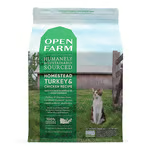
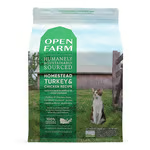
Rank 2: Open Farm Grain-Free Cat Food Turkey + Humanely Raised Chicken 8lb (OFTC-8C) — This offering is a dry kibble. It incorporates a dual protein blend of turkey and humanely raised chicken. Consistent with the "grain-free" designation, it does not contain common grain ingredients. This formulation is intended for adult feline nutrition. It is supplied in an 8lb bag.
Rank 3: Open Farm Grain-Free Cat Food Pasture-Raised Lamb + Vegetables 8lb (OFLB-8C) — This product is a dry kibble. Its main animal protein is pasture-raised lamb, supplemented by various vegetables. The formulation adheres to a grain-free standard. It is balanced for adult cat consumption. The product is packaged in an 8lb size.
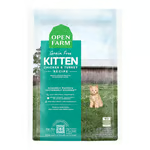
Rank 4: Open Farm Grain-Free Kitten Food Humanely Raised Chicken + Turkey 4lb (OFK-4C) — This is a dry kibble specifically formulated for kittens. The protein sources include humanely raised chicken and turkey. It is a grain-free recipe, developed to support the growth and developmental needs of young cats. The product comes in a 4lb bag.
Rank 5: Open Farm Grain-Free Cat Food Turkey + Humanely Raised Chicken 4lb (OFTC-4C) — This dry kibble is an adult cat formulation. It features turkey and humanely raised chicken as its primary protein components. The recipe is grain-free, aligning with the brand's common dietary approach. This specific product is provided in a 4lb package.
Open Farm Cat Food: Quality Standards and Labeling Norms
The quality standards for Open Farm cat food are reflected in its ingredient sourcing and manufacturing processes, often communicated through specific labeling. The brand frequently highlights its commitment to traceable ingredients, which entails the ability to identify the origin of each component used in the food. This traceability is sometimes supported by third-party certifications or internal auditing processes. For animal protein sources, terms like "humanely raised," "wild-caught," or "pasture-raised" are utilized to describe specific animal welfare or environmental standards adhered to by their suppliers. These terms generally refer to practices that exceed conventional industry norms, although the precise definitions can vary. Ingredient lists are typically presented in descending order by weight, as mandated by regulatory bodies like the Association of American Feed Control Officials (AAFCO) in the United States, providing transparency regarding the primary constituents. Nutritional adequacy statements, also required by AAFCO, specify for which life stage the food is formulated (e.g., "complete and balanced for adult maintenance" or "for growth and reproduction"). Such statements confirm that the product meets established nutrient profiles. Furthermore, the absence of common allergens or controversial ingredients, such as grains, artificial colors, flavors, or preservatives, is often explicitly stated on packaging, providing additional information about the Open Farm cat food profile.
Open Farm Cat Food: Verifiable Insights
A verifiable insight related to Open Farm cat food and its broader category involves the concept of ingredient "human-grade." While the term "human-grade" is frequently used in pet food marketing, its specific regulatory definition and application can vary. In the context of Open Farm cat food, "human-grade" typically means that all ingredients in the product are fit for human consumption, and the product is manufactured in a facility that meets human food safety standards. This is distinct from "feed-grade" ingredients, which are suitable for animal consumption but do not necessarily meet the same stringent standards for human consumption. Another factual insight pertains to the inclusion of novel protein sources within certain Open Farm cat food formulations. Novel proteins are less common animal proteins (e.g., lamb as opposed to chicken or beef) that may be used in pet food to address sensitivities or allergies in some felines. The strategic incorporation of such proteins, along with a grain-free composition, aims to provide dietary options for cats with specific nutritional requirements, distinguishing these formulations from more conventional pet food offerings. This approach reflects a particular segment of the pet food market. The attention to sourcing and processing methods for Open Farm cat food underscores a defined production philosophy.
The information presented provides a structural and compositional overview of Open Farm cat food, detailing its forms, ingredient attributes, processing methods, and relevant quality benchmarks. This descriptive framework is intended to clarify the characteristics of the category.
......View All